Welcome to the GenomeCompendium
Explore complete prokaryotic genomes in the context of enriched metadata, results of additional computations (repeats, intragenomic 16S rRNA copies etc.) + links to other resources — all in one place.
Use this platform to browse and query genome features (e.g. potential assembly errors), download reports, or perform an integrated analysis of your own/proprietary genome sequences with
GENARA (Genomic Analysis of Repeats and Annotations).
For RefSeq genomes, dedicated proteogenomics databases have been generated to enable researchers to improve the genome annotation of their favorite prokaryotic models.
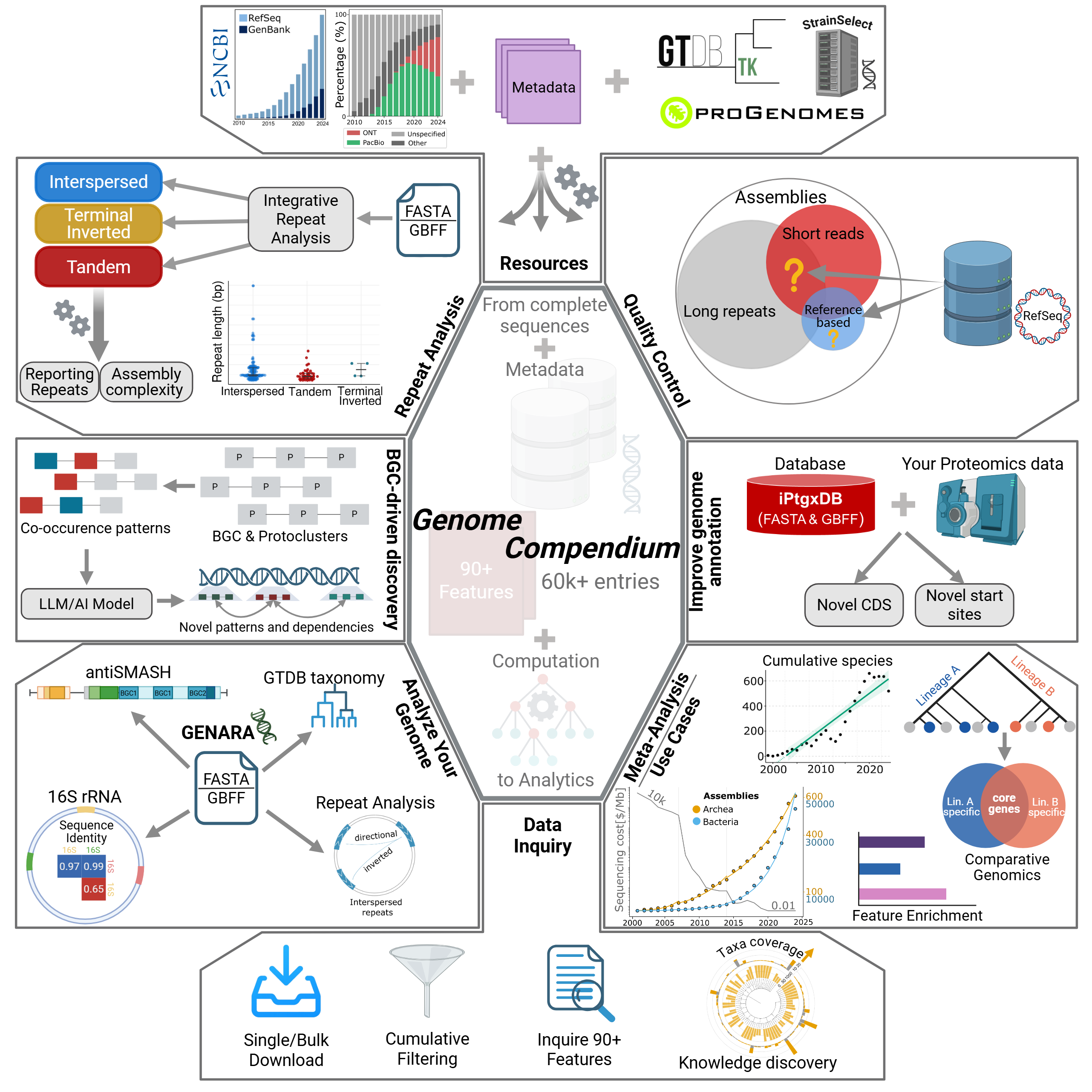
GenomeCompendium Overview
The GenomeCompendium is a public resource focusing on completely sequenced genomes of bacteria and archaea.
Complete genomes represent the most accurate basis for downstream functional genomics studies and to elucidate mechanistic insights into various functions.
The compendium supports researchers in bridging the gap from studying microbiome composition (e.g. amplicon sequencing) towards optimizing synthetic microbial consortia of available, fully sequenced strains (microbiome engineering) and studying their functions.
Purpose
The GenomeCompendium can be used to:
- Identify strains that are flagged for potential assembly errors
- Download pre-computed genome reports (example report) for sets of the ~47K RefSeq and ~13k Genbank strains.
- Analyze your own prokaryotic genomic sequence data for a repeat analysis, antiSMASH-based biosynthetic gene cluster (BGC) annotation, 16S rRNA identification (and sequence comparison), and GTDB taxonomy assignment using the GENARA tool.
- Select and visualize subsets of the ~60k genomes and ~90 features for explorative data analysis and mining.
- Assess the coverage of taxonomic ranks (e.g., species, genus) with at least one completely sequenced strain over time
- Perform comparative genomics (core, accessory, and strain-specific genes) and explore genotype–phenotype relationships.
- Download any of ~47,000 integrated proteogenomics search databases (RefSeq strains) to improve their genome annotation, i.e., find proteomics evidence for so far missed protein coding genes.
Workflow and Data Integration
Data is sourced from NCBI RefSeq and NCBI GenBank, complemented with metadata and in-house analyses, including repeat sequence analysis and visualization, intragenomic 16S rRNA sequence identity analysis, as well as cross-links to other resources.
First, repeats are identified and filtered for each genome sequence, while metadata mining is used to complement and enrich the extracted information. Summary-level plots, such as repeat distributions based on type and genomic location, are generated to provide an overview of repeat patterns.
Subsequently, a series of additional analysis steps are performed. These include assigning GTDB taxonomy, computing it using the GTDB-Tk tool when not available in the source databases, identifying biosynthetic gene cluster (BGC) regions and performing enrichment analysis and computing 16S rRNA sequence similarity scores if multiple copies are encoded in a respective genome that differ in their sequence. Lastly, for each genome in the database, all analysis results are compiled into a comprehensive report.
In addition, integrated proteogenomics databases (iPtgxDBs) are generated for each RefSeq entry to assist researchers in proteomics-based discovery of three types of novelty: novel protein-coding genes (CDS) missed by RefSeq, novel start sites for annotated CDS, and expressed pseudogenes. These small custom iPtgxDBs are created by integrating annotations from RefSeq, the ab initio gene predictor Prodigal, and the global microbial smORFs catalog GMSC. The novel CDS often include short ORF-encoded proteins (SEPs), which can carry out critical biological functions. For more information, visit the iPtgxDBs resource.
Cross-linking to External Resources
Where available, we cross-reference to information from the following external resources:
- GTDB Taxonomy: Genome-centric taxonomy classification.
- ProGenomes: Provides refined and consistent annotations for complete genomes and short-read-based assemblies.
- StrainSelect: Supplies strain procurement and reference information.
Using the GenomeCompendium Resource and GENARA Webtool
Below we briefly describe the main functionalities and purposes of the GenomeCompendium and GENARA webtool components.
Database Query Tab
This is the main access point to the GenomeCompendium full data table. Users can filter and query the database live, download results, reports, antiSMASH and repeat analysis outputs, as well as pre-generated iPtgxBD databases that can be used to improve the genome annotation of any RefSeq strain.
Repeat and Metadata Download
Users can download pre-computed analyses for one or multiple files by providing accession identifiers separated by commas in the corresponding field ("Accessions").
Important: The ID search uses permissive partial matching, allowing proper accessions (with or without version numbers).
Results are provided as compressed archives.
When downloading multiple files, do not refresh or close the browser, as this will interrupt the server connection. No background download processes are initiated.
Files and Content
- Reports: Detailed PDF reports summarizing enriched metadata, repeat analysis summaries, 16S rRNA, antiSMASH results, NCBI and GTDB taxonomy information, proteogenomic database information, and links to external references. These reports complement and extend the data found in the main data table. These files can also be downloaded by constructing query URLs in the format genome-compendium.com/Report/{AccessionID}.
- Repeats File: BED archives containing genomic coordinates of all identified repeat regions. Note: These include all detected repeats, not just the filtered ones that were used for downstream analyses. The files can also be downloaded using query URLs in the format genome-compendium.com/Repeats/{AccessionID}.
- BGCs File: GBK archives containing antiSMASH results for each analyzed genome, including protoclusters, BGC regions, and enriched BGCs. Summaries are also included in the full data table and reports. Use query URLs in the format genome-compendium.com/BGCs/{AccessionID} to download these files.
- iPtgxDB File: Archives containing the pre-computed iPtgxDB proteogenomics search database and a summary output (how many CDS were integrated from which annotation source, etc.). These can be used with public proteomics search engines such as MSFragger and proteomics data to improve the genome annotation. Important: Follow the iPtgxDB web server guidelines for correct usage and data interpretation. These files can also be downloaded using query URLs in the format genome-compendium.com/iPtgxDB/{AccessionID}.
- Sequences File: The input genome sequences used for the analyses. Use query URLs in the format genome-compendium.com/Sequence/{AccessionID} to download these files.
Query and Explore
Around 90 features can be queried across ~60,000 genomes, including mined metadata and analysis results. Missing entries are marked as “–”.
The database table can be filtered using the three provided query fields ("Column selector - Rule type - Value"). Each column is recognized as either numeric or text-based, and the filtering interface adapts accordingly. Numeric fields allow mathematical comparisons, while text fields enable flexible string matching.
- After pressing “Add Query (+)”, subsequent queries are applied cumulatively, allowing complex filtering.
- Active queries are listed at the top of the page.
- Use “Reset All Queries” to clear all filters.
- All columns are visible by default but can be customized through the “Add/Remove Columns” field.
- The full data table or a filtered subset can be downloaded after applying the queries.
GENARA Tab
The GENARA tab enables on-demand analysis of any complete prokaryotic genome including repeat detection, GTDB taxonomy classification, antiSMASH annotation, and 16S rRNA identification. A genome analysis typically takes about five minutes.
Properties
- Supported input formats: GBFF, FASTA, or compressed GBFF archives. Multiple files can be uploaded simultaneously. Example files are provided. Important: File names and internal content must conform to the provided examples to ensure full pipeline compatibility and avoid processing errors.
- Analyses run in the background — users are not required to keep their browser open during execution.
- When an email address is provided, a notification for a finished analysis will be sent automatically (optional).
- Results can be downloaded from the Results ID using the unique Analysis ID generated after submission. For security and storage reasons, results are automatically removed from the server after five days. Retrieval is not possible beyond this period.
Selected applications and examples
The figure below illustrates three typical research scenarios.
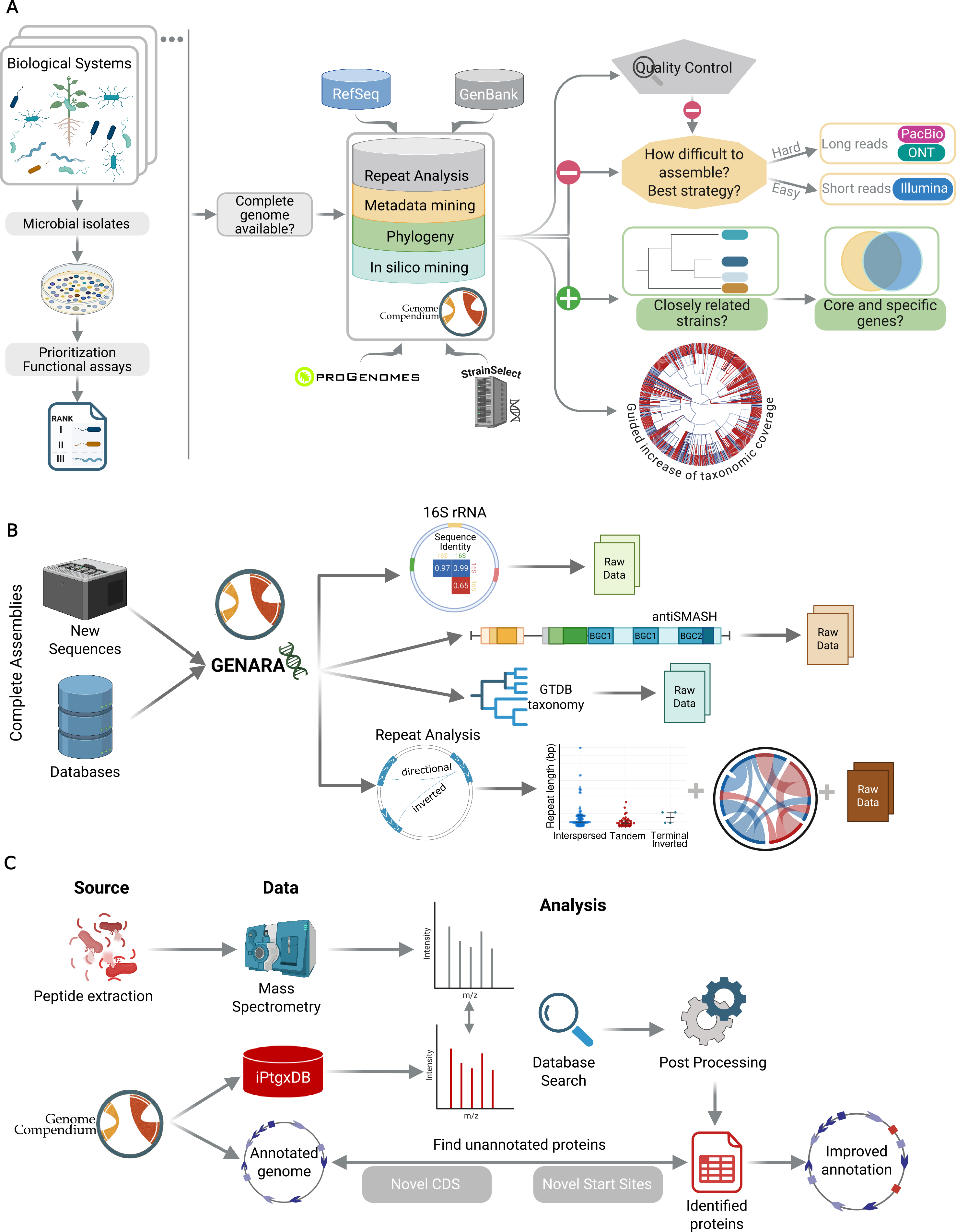
(A): Planning and prioritizing sequencing efforts
A typical entry point is a set of isolates prioritized in your own biological system, for example after functional screening. Querying the compendium then informs several decisions before any sequencing is done:
- Determine whether a complete genome already exists for a strain — and if not, whether sequencing it would add the most taxonomic novelty.
- Where one does exist, check whether it carries a quality flag (reference-guided assembly, or long repeats despite short-read-only metadata) that would justify generating a new long-read assembly.
- Compare the repeat-based complexity classes (Koren scores) of related strains to anticipate assembly difficulty and adapt the strategy accordingly, e.g. performing very long reads when class III genomes are frequent.
- Assemble phylogenomic subsets of closely related complete genomes as a basis for core, accessory and strain-specific gene analysis, and for linking phenotypic observations to genotypic differences.
(B): Characterizing a newly sequenced genome
Once a genome is assembled, GENARA applies the same analyses used to build the compendium to your own sequence, so that results are directly comparable with the ~60,000 entries in the database. The repeat profile serves as an independent quality check on the assembly, the 16S rRNA copy comparison helps interpret amplicon-based OTU counts for the same organism, GTDB assignment places the strain in a standardized taxonomic framework, and the antiSMASH output highlights its biosynthetic potential.
(C): Refining an existing genome annotation
Even in well-studied model organisms, a substantial number of protein-coding genes remain unannotated: in Escherichia coli, roughly 140 CDS encoding proteins shorter than 50 aa were identified and experimentally validated over the course of a decade. The pre-computed iPtgxDBs make this type of discovery accessible for any completely sequenced RefSeq strain: combined with mass spectrometry-based proteomics data, they allow nearly every identified peptide to be assigned unambiguously to a single protein entry, revealing missed CDS, alternative start sites, expressed pseudogenes and short ORF-encoded proteins (SEPs) in your organism of interest.
Acknowledgements and Citation
If you use this resource in your research, please cite the GenomeCompendium and GENARA webtool:
GenomeCompendium: A database for the integrated analysis of repeats, assembly quality and functional content of complete prokaryotic genomes (2026).
Contact and Support
support@genomecompendium.com
Analyze your data
Video Tutorial
Coming soon.
Selection of figures and diagrams that show the status of complete prokaryotic genomes at NCBI RefSeq
Interactive completeness plot highlighting taxonomic areas with few or no complete genomes, shown at the Phylum-Genus level. The completeness ratio represents the number of assemblies for the respective taxonomic rank that are complete compared to all other assembly levels (Contig, Scaffold, or Chromosome) for that rank. Navigation tip: Once you have clicked on and zoomed into a tile (taxonomic subgroup), you can return to the upper level by clicking on the upper-left corner of the picture.
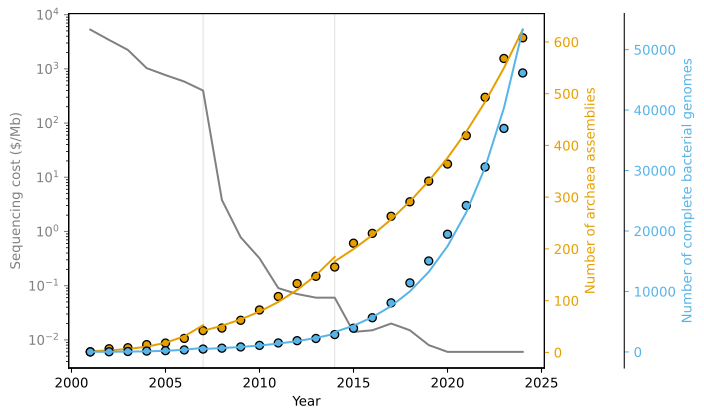
The cumulative increase of the number of complete genomes over time (2001-2024) is substantially slower for archaea (orange) compared to bacteria (light blue); for the data points from 2001-2007, 2007-2014 and 2014-2024 separate linear regressions on log-transformed data were carried out (fitted orange and blue lines, respectively) to capture the years with exponential growth.
Phylogenetic tree showing RefSeq genera with no complete assemblies or for which fewer than 20% of all assemblies are complete. Only genera with five or more assemblies are considered. Navigation tip: You can move the plot with your mouse and zoom in using the wheel.